
Navigating Risk Terminology
|
|
By Jeff Hargis
|

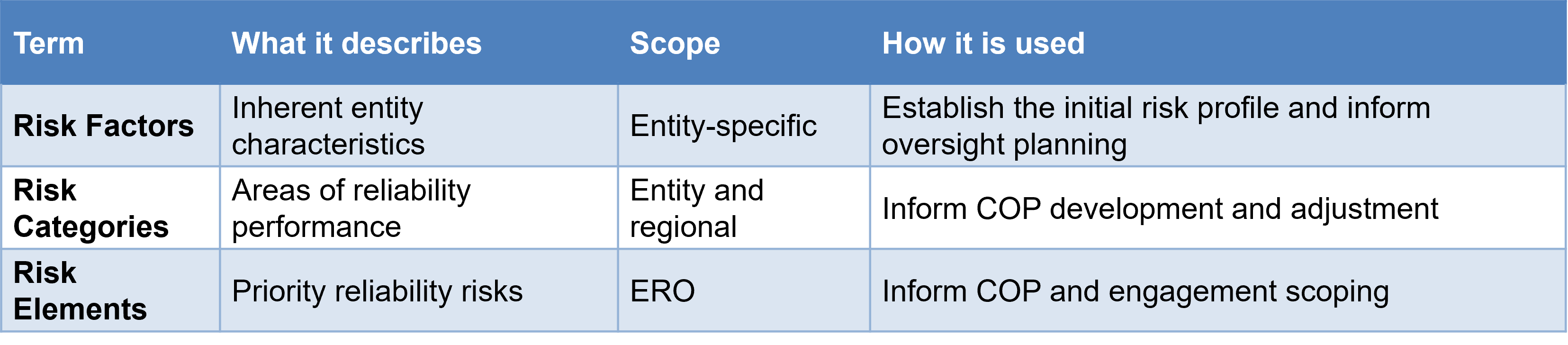
The Electric Reliability Organization (ERO) Enterprise uses several related terms to describe how it evaluates and responds to reliability risk. Three of the most common terms: Risk Factors, Risk Categories, and Risk Elements, serve different purposes, but their similarities can make them difficult to distinguish.
The distinction is important: Risk Factors describe characteristics inherent to an entity; Risk Categories describe areas of reliability performance; and Risk Elements identify system-wide priorities for focused monitoring. Together, these concepts help the ERO Enterprise direct regulatory oversight toward the reliability risks that warrant the greatest attention.
Risk Factors: Inherent Entity Characteristics
Risk Factors describe characteristics inherent to an entity’s registered functions, assets, operating characteristics, and reliability responsibilities. As the starting point for risk assessment, they typically do not change often for a registered entity. Examples include an entity’s CIP impact rating, total generation capacity, and responsibilities for system restoration, undervoltage load shedding (UVLS), or Remedial Action Schemes. There are eighteen Risk Factors, and no entity in the ERCOT Interconnection has all of them.
Risk Factors provide a foundation for compliance oversight and serve as an initial filter when Texas RE considers which Standards and Requirements are relevant to an entity. For example, the absence of UVLS circuits removes the UVLS Risk Factor and may remove associated Standards or Requirements from consideration during oversight planning, subject to the applicable registration and Standards framework. When a Risk Factor applies, Texas RE assigns a High, Medium, or Low rating using objective criteria. The rating informs risk analysis and engagement scoping. An entity with a High rating for the Workforce Capability Risk Factor, for example, is more likely to see PER-005 included in an audit scope than an entity with a Low rating.
Risk Categories: Areas of Reliability Performance
Risk Categories describe areas in which an entity’s reliability performance may affect risk. Examples include performance in the following areas:
- Normal System Operations
- Emergency Operations Planning
- System Protection
- Asset/System Physical Protection
- Identity Management and Access Control
During a risk assessment, Texas RE reviews information such as event history, compliance history, internal controls, and other available performance data. This information helps determine whether a Risk Category should influence the entity’s Compliance Oversight Plan (COP).
The presence of a Risk Category in a COP does not necessarily indicate deficient entity performance. Texas RE may include a category because the risk is relevant across the Interconnection or to a class of registered entities. For example, a Transmission Owner may see System Protection in its COP even without a high misoperation rate. Conversely, strong performance and effective internal controls may support removing that Risk Category from the entity’s current COP.
Risk Elements: North American Monitoring Priorities
Risk Elements identify reliability risks selected for focused monitoring across North America. They are established through the annual CMEP Implementation Plan after a review of risks to the Bulk Electric System over the preceding year. Risk Elements may be broad, such as Grid Transformation, or focused, such as Facility Ratings. While they inform the risks in an entity’s COP, they primarily help shape engagement scopes. If Facility Ratings are identified as a Risk Element, for example, FAC-008 may be more likely to appear in the scope of a scheduled engagement for an applicable entity. That likelihood may decrease when recent oversight has already demonstrated that the entity has effectively mitigated the risk.
Putting the Terms Together
Together, these concepts move from the entity-specific to the system-wide. Risk Factors establish an entity’s underlying risk profile. Risk Categories identify performance areas that may warrant attention. Risk Elements bring broader ERO priorities into engagement scoping. Used together, they help the ERO Enterprise align oversight with the most significant reliability risks. Although that oversight is often associated with compliance audits, it also includes outreach, data collection, and other interactions with industry that are not directly related to compliance.
Key Distinctions